
What It Will Take To Solidify New African Supply Corridors into Saudi Arabia
FEATURED BLOG
What It Will Take To Solidify New African Supply Corridors into Saudi Arabia
—
Aug 2026
Saudi Arabia is entering a period where the scale of its economic transformation is placing greater emphasis on the reliability of the supply chains that support it. Vision 2030 continues to drive demand across food, livestock, construction and industrial inputs, while disruption around the Strait of Hormuz and renewed insecurity at Bab el-Mandeb have increased the premium on suppliers that can deliver consistently despite a more complex regional logistics environment.
This is also happening as Saudi Arabia’s commercial engagement with African markets accelerates. Business roundtables, bilateral agreements, export-finance partnerships and investment announcements are bringing Saudi buyers and institutions into closer contact with producers in markets including Kenya, Ethiopia, Nigeria, Mauritania, Guinea and Algeria. ⁴ But access is only the first step. Roundtables and MoUs will translate into sustained trade only where exporters can meet Saudi standards, deliver sufficient volumes and build routes capable of absorbing disruption.
Türkiye offers an indication of what that readiness can achieve. While not a one to one comparison to some African examples mentioned here, Turkiye offers a mechanism of reliable supply amidst demand-side shifts that African countries can adopt. Its exports to Gulf markets reportedly rose 41% year-on-year to $2.6 billion in June 2026, while exports to Saudi Arabia reached $425 million, up 117%.⁵ The lesson is not to replicate Türkiye’s product mix, but its ability to convert shifts in demand into reliable supply at speed. That same test is emerging across three areas where Saudi demand and existing production capabilities increasingly intersect: agri-food, halal livestock and meat, and construction and steel inputs.
Agriculture is one of the strongest proof points for market-building in displacement settings. It is a sector where demand, production, and trade can be structured into coherent, investable value chains. The opportunity is not just more food. It is the set of businesses around production, including inputs and services, aggregation, storage, processing, logistics, and reliable offtake, that link displaced and host producers into the same commercial loops. Constraints like informality, and weak infrastructure are real, but they are workable with the right model design. With strong intermediaries and risk-sharing, capital can move beyond subsistence into scalable firms that grow jobs, productivity, and trade.
East Africa can tap into Saudi opportunity through improved export readiness
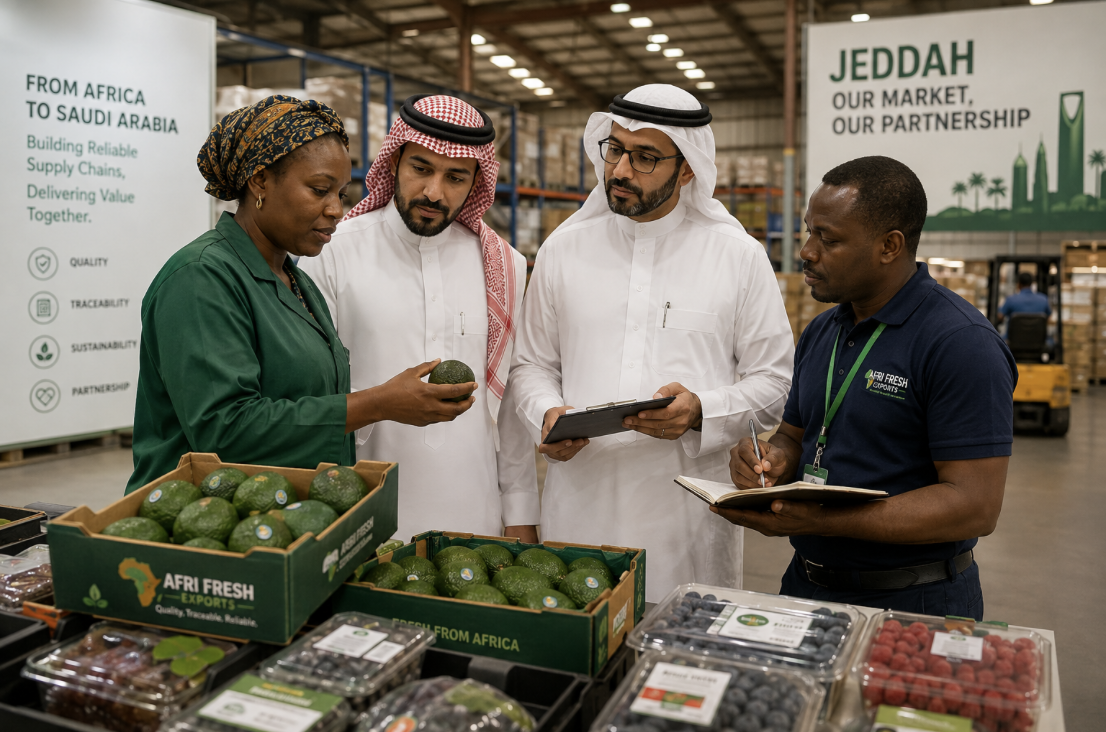
Kenya is well positioned to expand agricultural trade with Saudi Arabia. Horticulture, meat, dairy and leather were among the high-potential sectors highlighted at the Saudi–Kenya Business Round Table in Riyadh in July, while Saudi EXIM Bank and the Kenya Development Corporation extended their cooperation framework until 2029. ⁴
Yet identifying demand has proved easier than converting it into sustained exports. Kenya’s State Department for Livestock has acknowledged that the country has fallen short of its Gulf meat-export ambitions despite strong demand, citing logistics bottlenecks, certification gaps, limited cold-chain infrastructure and insufficient Gulf-compliant slaughterhouse capacity.⁶
The same export-readiness question matters for Ethiopia. High-value perishables can reach Saudi Arabia relatively quickly by air, but greater reliance on aviation places more pressure on domestic cold-chain systems. Maersk’s 2025 assessment of East African agricultural logistics found that Ethiopia’s cold-chain infrastructure remains uneven outside its principal export hubs, with unreliable power, limited refrigerated storage and transport gaps constraining agricultural supply chains even as capacity at Addis Ababa Bole International Airport expands.⁷
Maritime routes offer lower costs but introduce another exposure. Cargo from Mombasa, Djibouti and ports farther south must pass through the Gulf of Aden and Bab el-Mandeb to reach western Saudi Arabia. Air freight can provide resilience for high-value perishables when maritime risk rises, but remains too expensive for many lower-margin products. Proximity therefore creates an opening, but not a guarantee. Scaling the East Africa–Saudi corridor will require stronger cold chains, compliant processing facilities, predictable sanitary and halal certification, dependable air-cargo capacity and longer-term procurement relationships with Saudi buyers.
Nigeria offers route diversification in halal trade
Nigeria offers a different proposition where alternative routes away from conflict zones define the opportunity In February 2026, it launched a national halal economy strategy developed with Saudi Arabia’s Halal Products Development Company, a Public Investment Fund-owned entity, building on a bilateral agreement signed in 2025.⁸ Its opportunity lies not in competing with East Africa on distance, but in offering a complementary route and product base. Cargo from Nigerian Atlantic ports can travel through Gibraltar, the Mediterranean and Suez before reaching Jeddah or Yanbu, avoiding both Hormuz and Bab el-Mandeb.
That gives Nigeria a potential role in diversifying Saudi halal supply chains, provided livestock production can be converted into Saudi-compliant frozen meat and processed food. Doing so will require the same enabling systems needed across East Africa: recognised certification, stronger veterinary controls, export-approved abattoirs, traceability, meat and poultry value addition that meets the standards and cold-chain investment. The distinction, however, is in the logistics proposition: East African producers can offer speed, while Atlantic-facing suppliers can offer greater route resilience.
Saudi construction demand opens another industrial opportunity
The third opportunity sits upstream in Saudi Arabia’s construction and steel economy. The Kingdom awarded SR30.03 billion, or approximately $7.99 billion, in construction contracts in May 2026 alone, the highest monthly value recorded that year.⁹ Saudi Arabia has no domestic iron-ore production, while close to 75% of finished steel consumption is linked to construction, increasing the strategic importance of imported ore, pellets and related inputs.⁰
Mauritania already demonstrates how this demand can translate into deeper industrial integration. Takamul, the 50-50 Saudi–Mauritanian mining and steel joint venture, plans to produce up to 10 million tonnes of direct-reduction-grade iron-ore pellets annually, primarily for Saudi steelmaker Hadeed. The significance lies in more than the volume. The project connects Saudi industrial demand directly with beneficiation in Mauritania and a long-term buyer relationship. Its Atlantic-Suez route into western Saudi Arabia also bypasses Bab el-Mandeb, a zone exposed to regional vulnerabilities, giving it a degree of route diversification at a time when access through the southern Red Sea remains vulnerable to geopolitical shocks.
Mauritania is therefore a useful proof of concept for other mineral producers in Africa. Guinea’s Simandou project is expected eventually to reach around 120 million tonnes of high-grade iron-ore production, giving it potential relevance to Saudi Arabia’s direct-reduction steel industry. Similarly, Algeria’s Gara Djebilet project is targeting approximately 4 million tonnes of iron concentrate annually and benefits from direct Mediterranean access to Suez.
The opportunity is not simply to export more raw minerals. It is to move further into the Saudi steel value chain through beneficiation, pellets, ferroalloys, semi-finished products and long-term offtake arrangements.
From trade opportunities to dependable corridors
The present disruption should not be read simply as a short-term opportunity to redirect goods toward Saudi Arabia. Its more important effect is to raise the value of suppliers that can combine competitive production with dependable logistics.
That requires different solutions by sector. For Kenya and Ethiopia, the priority is reliable agri-food corridors supported by cold chains, air cargo and predictable procurement. For Nigeria, it is turning halal production potential into Saudi-compliant exports while making better use of Atlantic–Suez access. For Mauritania, Guinea and Algeria, it is connecting mineral production more directly to Saudi steel demand through processing, long-term offtake and routes that reduce exposure to the southern Red Sea.
Finance and buyer relationships will be as important as ports. The Saudi EXIM-Kenya partnership shows how institutional finance can begin to convert commercial engagement into actual trade flows.⁴ Similar arrangements could support cold-chain infrastructure, compliant processing capacity and direct links between Saudi industrial buyers and producers.
Saudi Arabia’s supply diversification therefore creates a series of distinct openings shaped by product competitiveness, export readiness and route geography. The countries that convert those advantages into reliable standards, infrastructure and buyer relationships will be better positioned to move beyond trade fairs and MoUs, and secure a more durable role in the Kingdom’s food-security and industrial strategies.
References
Reuters,Hormuz shipping traffic falls to one-week low amid hostilities, 12 August 2026.
Reuters,New attacks on shipping as Iran war talks hit fresh impasse, 11 August 2026. The article reports a suspected Houthi attack on a ship in the Bab el-Mandeb Strait.
Kenya National Chamber of Commerce and Industry,KNCCI Drives Strategic Economic Expansion at the Saudi-Kenya Business Round Table in Riyadh, 10 July 2026.
Saudi Press Agency,Saudi EXIM Strengthens Partnership with Kenya Development Corporation, 6 July 2026.
Salaam Gateway,Turkish exports to Gulf surge 41% as conflict disrupts Chinese supply chains, 21 July 2026, citing Türkiye Exporters Assembly data.
Business News Kenya,Gulf Meat Strategy Flops as Kenya Hits Reset Button, 26 February 2026.
A.P. Moller–Maersk,Strengthening East Africa’s Agricultural Logistics: Cold Chain Solutions for Global Exports, 19 August 2025.
State House, Federal Republic of Nigeria,Nigeria Taps into $7.7trn Global Halal Market as FG Launches National Economic Strategy, 5 February 2026.
Arab News,Saudi Arabia’s May construction awards hit 2026 high at $8bn, 16 June 2026, citing the Saudi Contractors Authority monthly sector report.
Ministry of Industry and Mineral Resources, Saudi Arabia, Daleel platform,Mining Downstream – Steel. The platform notes Saudi Arabia has no domestic iron-ore production and relies on imported DR-grade pellets and scrap; its Arabic version also reports construction accounts for approximately 75% of finished-steel consumption.
Mauritania Saudi Mining and Steel Company (Takamul),About Us, project documentation on the Saudi–Mauritanian joint venture, production and planned iron-ore pellet supply.
Reuters,Guinea aims for global high-grade iron ore leverage with Simandou launch, 12 November 2025.
Algerian Radio,Working Meeting to Follow Up on the Gara Djebilet Iron Ore Valorization Project, 31 March 2026, citing the Algerian Investment Promotion Agency.